
Why Buildings Pass Startup but Fail Functional Testing
A successful equipment startup confirms valuable prerequisites, but it does not demonstrate that sensors, controls, interlocks, systems, and operating modes work together.
Startup and functional testing are complementary quality activities with different boundaries. Projects fail when a startup form is treated as proof of integrated performance or when functional testing is forced to become unfinished startup work.
Technical overview
Startup Versus Function: field logic map
Passing startup is necessary, not final
Manufacturer and contractor startup confirms that equipment is installed sufficiently to energize, rotate, heat, cool, pump, communicate, or otherwise perform basic functions. The work may include lubrication, torque, rotation, electrical checks, refrigerant checks, safeties, setpoints, and factory-specific measurements. That evidence is essential to protect equipment and prepare the system for testing.
The startup boundary usually ends at the equipment package. A chiller can produce cold water while the plant stages incorrectly. An air handler can start while its outdoor-air control fails at minimum speed. A generator can carry load while transfer, shedding, alarms, and restoration do not follow the required sequence.
Functional testing follows the operating story
Functional testing begins with the approved sequence and owner requirements. It commands or creates defined conditions, records expected responses, and evaluates acceptance criteria. Normal operation is only one part of the story. Transitions, part-load behavior, alarms, safeties, failure modes, recovery, and interaction with other systems often reveal the most important deficiencies.
A useful test does not merely watch points change color on a graphic. It verifies the physical response with credible measurements, observes timing and stability, confirms alarm handling, and documents the configuration under which the result was obtained.
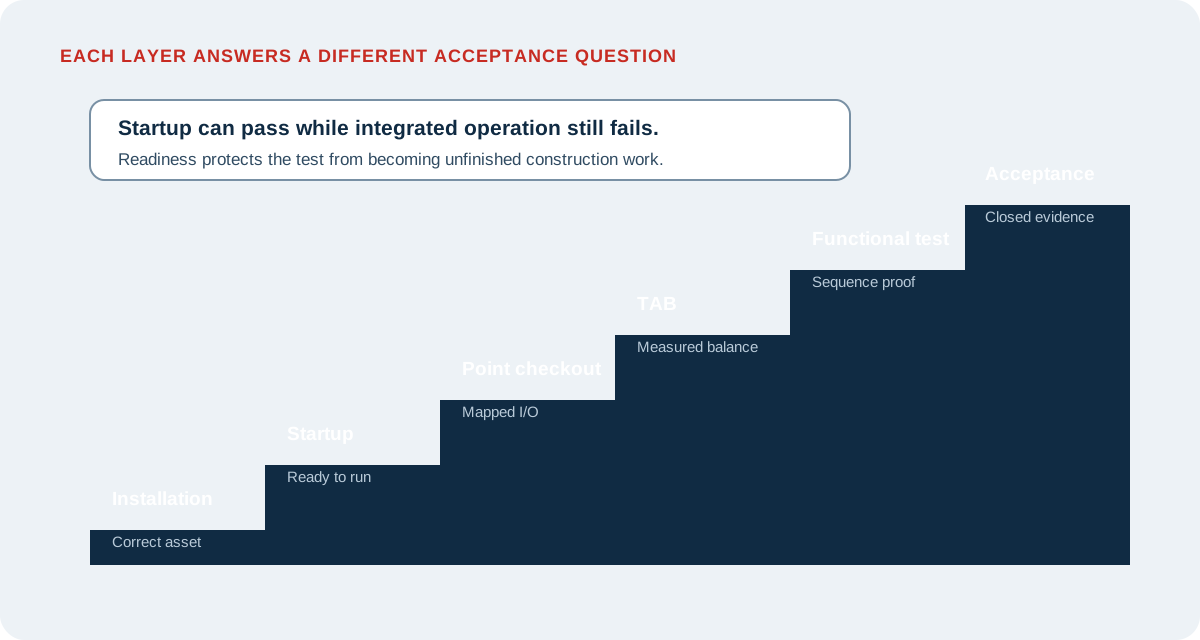
Common gaps between package operation and building performance
Integration defects include reversed sensors, incorrect units, mismatched scaling, disabled safeties, overrides, undocumented setpoints, network mapping errors, incomplete interlocks, unstable loops, incorrect lead-lag rotation, simultaneous heating and cooling, inaccessible alarms, and recovery sequences that require manual intervention.
Many of these defects do not prevent startup. They appear only when the system is tested as an assembly under controlled conditions. That is why the project team should not collapse startup, point checkout, TAB, controls checkout, and functional testing into one checkbox.
Readiness protects both schedule and evidence
Before functional testing, confirm approved submittals and sequences, completed startup, point-to-point checkout, sensor calibration, TAB readiness, active safeties, stable communication, cleared critical deficiencies, configured trends, and the availability of responsible technicians. The readiness decision should be based on evidence, not calendar pressure.
If prerequisites are incomplete, document the limitation and reschedule the affected test. Troubleshooting may still be useful, but it should not be recorded as a passing functional test. Acceptance evidence must describe the final corrected configuration.
Use failures to improve the system—not weaken the test
A failed functional test is information. The response should identify cause, assign corrective work, control changes, retest the affected step, and evaluate whether the correction changes other modes. Acceptance criteria should not be relaxed merely because the installed system misses them.
The strongest closeout record links startup, TAB, controls checkout, functional testing, deficiencies, corrections, and retests. That chain shows the owner not only that equipment ran, but that the completed building demonstrated the required behavior.
Field application
A practical review checklist
- 01
Define the scope and acceptance evidence for startup, TAB, controls checkout, and functional testing.
- 02
Confirm startup records are complete, equipment-specific, and tied to the installed asset.
- 03
Resolve critical readiness items before assembling the functional-test team.
- 04
Translate every material sequence mode and transition into a controlled test step.
- 05
Verify physical response in addition to BAS command and feedback values.
- 06
Record configuration, setpoints, overrides, instruments, timing, and stability.
- 07
Track every failed step through correction and repeatable retest.
- 08
Confirm a correction in one mode does not create a defect elsewhere.
Related Free tools
Put the relationships to work.
Authoritative orientation
References and further reading
Use the current adopted or licensed edition applicable to the project. These links provide public orientation and do not reproduce protected standards.
Continue exploring
One article. 235 free engineering calculators.
Move from the concept to a transparent calculation, or return to the complete Insights collection.