
Commissioning A2L Refrigerant Systems: A New Verification Boundary
Lower-GWP refrigerants change equipment, safety controls, documentation, installation practices, and emergency response expectations that commissioning teams must understand.
A2L refrigerants are mildly flammable and are being applied under updated product standards, safety standards, codes, and manufacturer instructions. Commissioning should verify the project’s approved safety concept without improvising requirements in the field.
Technical overview
Commissioning A2L Systems: field logic map
The refrigerant transition reaches the jobsite
Federal technology-transition requirements are moving many new air-conditioning and heat-pump products toward lower-global-warming-potential refrigerants. Some commonly selected replacements are classified A2L, indicating lower toxicity and lower flammability under the applicable classification system. The result is not simply a different nameplate charge. Equipment construction, installation details, allowable applications, service tools, and safety sequences can change.
Commissioning providers should confirm the exact project requirements rather than issue universal A2L rules. The adopted mechanical, fire, electrical, and building codes; ASHRAE safety standards; listing; equipment instructions; refrigerant concentration limits; room geometry; and system charge determine what is required.
Establish the approved safety basis before testing
Submittal review should identify the refrigerant designation and safety class, factory and field charge, connected system volume, equipment location, occupied-space implications, required leak-detection or mitigation features, ventilation provisions, ignition-source controls, labeling, piping limitations, and service requirements. Conflicts among drawings, schedules, equipment selections, and manufacturer instructions should be resolved before startup.
Field changes can alter the basis. Revised line lengths, substituted components, additional charge, relocated equipment, room partitions, ceiling changes, and altered ventilation may affect the approved configuration. The final record should show the installed condition and the responsible design or code decision where a deviation required evaluation.
Verify installation and refrigerant-circuit integrity
Installation checks should address approved piping materials and joints, routing, mechanical protection, brazing or joining procedures, nitrogen purge where required, pressure testing, evacuation, dehydration, leak checks, charging by measured mass, service-port protection, labeling, clearances, condensate control, electrical classification where applicable, and manufacturer startup prerequisites.
Commissioning should review the contractor’s pressure, evacuation, and charge records for traceable instruments, stable conditions, corrected leaks, achieved targets, and circuit identification. The commissioning provider should not direct refrigerant handling beyond qualifications or project authority; the role is to verify documented compliance and witnessed performance.
Test mitigation as an integrated sequence
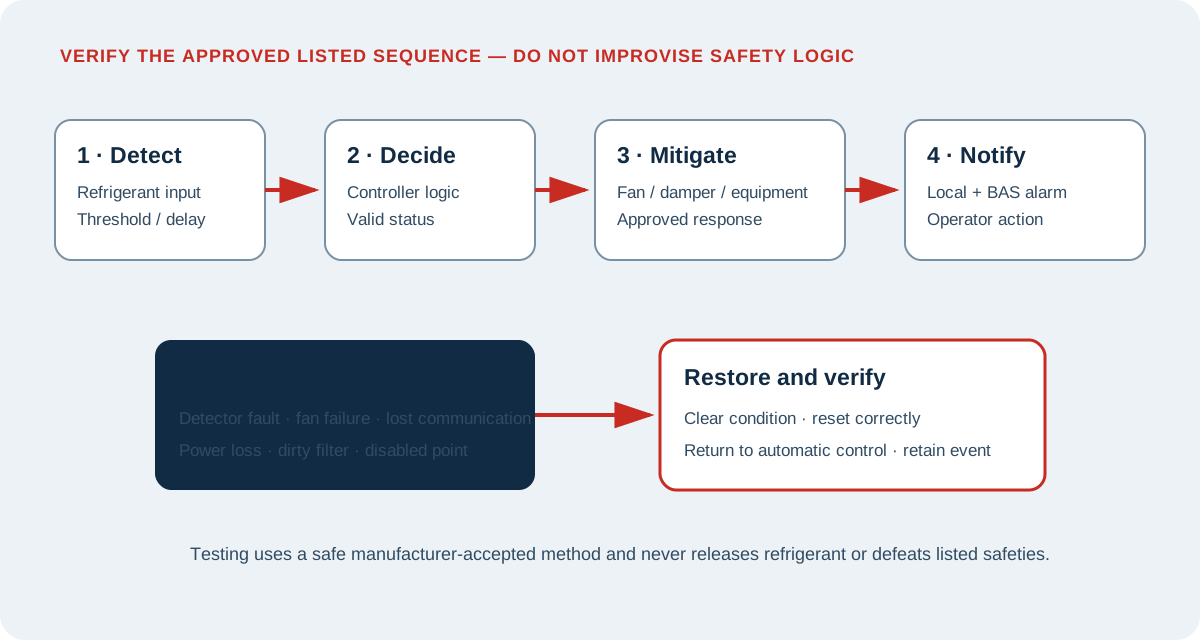
Where the listed system includes refrigerant detection or mitigation, test the complete approved sequence using a safe manufacturer-accepted method. Verify detector status, alarm thresholds, controller response, fan operation, damper or valve positions, compressor response, occupant notification where required, BAS monitoring, fault supervision, time delays, reset logic, and restoration after the simulated condition clears.
Failure modes matter. A disconnected detector, failed mitigation fan, loss of communication, power interruption, dirty filter, closed damper, or overridden point should produce the required alarm and safe response. Tests must be coordinated to avoid releasing refrigerant, defeating listed safeties, or creating an ignition or exposure hazard.
Turnover must prepare the operator and service organization
The owner needs the final refrigerant inventory, equipment and detector locations, safety sequence, alarm response, emergency contacts, required tools, service restrictions, detector maintenance, replacement intervals, training records, and applicable safety data. Equipment and room labels must remain visible after finishes and access panels are installed.
Seasonal performance testing still applies. Verify cooling, heating, defrost, oil management, heat recovery where provided, ventilation interaction, condensate management, and recovery from interruption. The new safety layer does not replace ordinary capacity, control, and reliability testing; it expands the system boundary.
Field application
A practical review checklist
- 01
Confirm refrigerant, safety class, total installed charge, room basis, listing, codes, and manufacturer instructions.
- 02
Reconcile piping layout and field-added charge with the approved design and final installation.
- 03
Review pressure-test, evacuation, leak-test, and charging records for traceable evidence.
- 04
Inspect labels, access, clearances, mechanical protection, penetrations, detectors, and mitigation components.
- 05
Test the approved leak-detection and mitigation sequence using a safe accepted method.
- 06
Challenge detector fault, communication loss, fan failure, and power-restoration responses where applicable.
- 07
Verify BAS points, alarms, histories, priorities, and operator instructions.
- 08
Complete seasonal capacity and operating-mode tests without bypassing listed safety functions.
Related Free tools
Put the relationships to work.
Authoritative orientation
References and further reading
Use the current adopted or licensed edition applicable to the project. These links provide public orientation and do not reproduce protected standards.
Continue exploring
One article. 235 free engineering calculators.
Move from the concept to a transparent calculation, or return to the complete Insights collection.