
The Problem with Deferred and Seasonal Commissioning Tests
Weather-dependent tests are often legitimately deferred, but without defined conditions, responsibility, access, funding, and deadlines, temporary deferral becomes permanent uncertainty.
Seasonal testing is a planned continuation of commissioning—not an administrative exception. The project needs a controlled register that preserves prerequisites, acceptance criteria, responsibilities, and leverage until the required conditions occur.
Technical overview
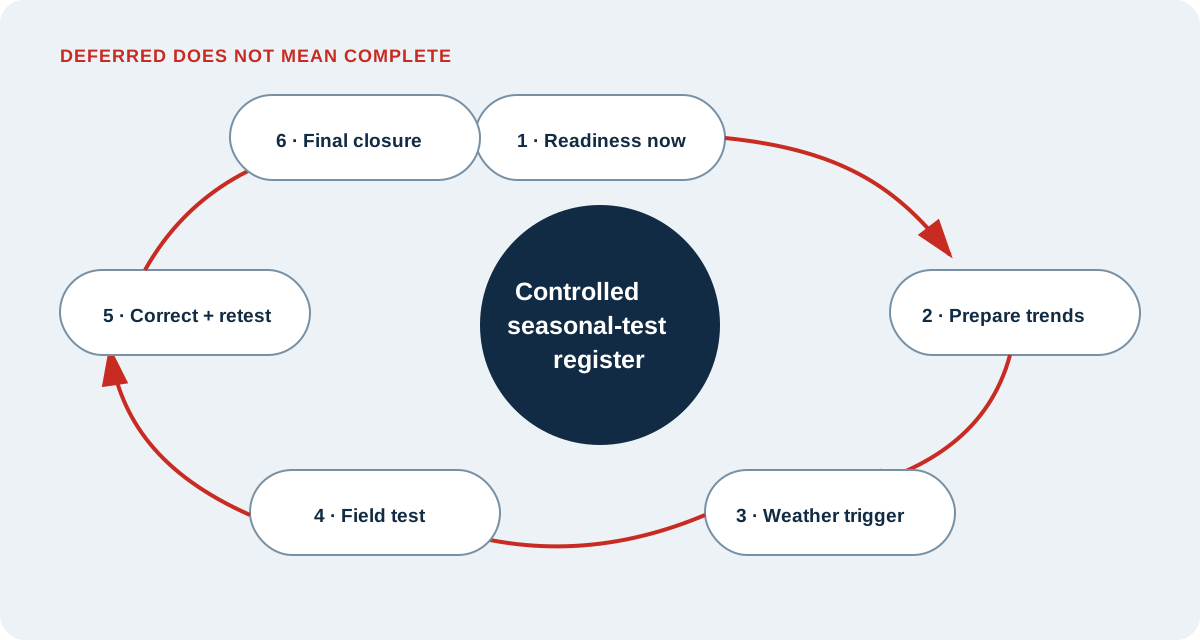
Deferred Seasonal Testing: field logic map
Weather does not follow the construction schedule
A building may reach substantial completion during mild weather when boilers cannot be loaded, cooling towers cannot reject design heat, economizers cannot cross changeover thresholds, heat pumps cannot demonstrate cold-weather capacity, and envelope conditions cannot be evaluated meaningfully. Deferral can be technically appropriate.
The problem begins when the deferred item is treated as complete for administrative convenience. Months later, project personnel have changed, access is difficult, trend points are missing, warranties are advancing, and the remaining budget is unclear. The owner inherits an unverified operating mode.
Define the trigger condition, not just the season
‘Test next winter’ is not a plan. State the required outdoor condition, load, equipment availability, occupancy condition, minimum duration, and acceptable simulation alternatives. Identify who monitors the forecast or operating data and who has authority to schedule the test.
Some tests can use overrides, load banks, temporary loads, or controlled setpoint changes. Simulation should preserve safeties and be evaluated against the purpose of the test. It may demonstrate sequence logic while leaving capacity, heat transfer, moisture, envelope, or sustained-load performance for later confirmation.
Maintain a live deferred-test register
Each item should identify system, reason for deferral, prerequisite, target condition, approved procedure, acceptance criterion, responsible contractor, commissioning witness, owner contact, access requirements, trend setup, notice period, funding or retainage mechanism, warranty relationship, and final deadline.
Review the register at every closeout meeting. Do not bury seasonal items in a general issue log where they appear indistinguishable from paperwork. The owner should receive a concise statement of what remains unproven and what operational risk that creates.
Prepare the evidence before demobilization
Configure and validate trends while the controls contractor is still engaged. Confirm sensor calibration, naming, sampling intervals, storage capacity, export format, and time synchronization. Capture baseline operation and verify that operator overrides will be visible.
Complete everything that does not require the seasonal condition: procedure review, readiness checks, alarm routing, safeties, valve and damper stroke, sensor comparison, setpoint calculation, mode enable logic, and recovery steps. Then the seasonal visit can focus on actual performance rather than unfinished checkout.
Close only after evidence and correction
When conditions occur, perform the approved test, document the actual weather and load, evaluate limitations, correct deficiencies, and retest. If the condition never occurs before the deadline, the owner should make an explicit disposition based on alternative evidence and residual risk—not allow the item to disappear.
The final commissioning report and systems manual should be updated after seasonal work. Operators who participated gain practical experience with the exact modes they will manage during extreme weather.
Field application
A practical review checklist
- 01
Identify every untested mode before substantial completion and state why it cannot be tested.
- 02
Define measurable weather, load, occupancy, and equipment-availability trigger conditions.
- 03
Assign the scheduling owner, required witnesses, notice period, access, funding, and deadline.
- 04
Complete nonseasonal readiness checks and validate trend collection before demobilization.
- 05
Distinguish what simulation proves from what remains for representative conditions.
- 06
Maintain the register through warranty and report remaining operational risk to the owner.
- 07
Document actual test conditions, limitations, findings, corrections, and retests.
- 08
Update the final report, systems manual, and operator training after closure.
Authoritative orientation
References and further reading
Use the current adopted or licensed edition applicable to the project. These links provide public orientation and do not reproduce protected standards.
Continue exploring
One article. 235 free engineering calculators.
Move from the concept to a transparent calculation, or return to the complete Insights collection.