
A TAB Report Does Not Prove Continuous Ventilation Compliance
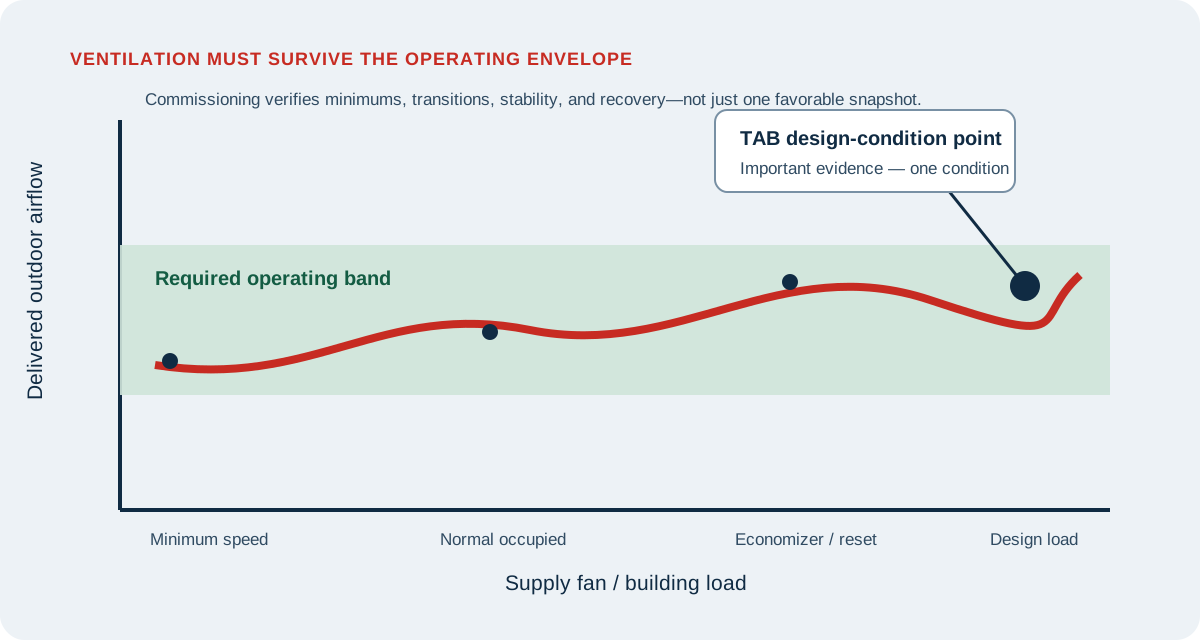
Design-condition airflow is important evidence, but occupied ventilation can fail as fans reset, dampers modulate, zones change mode, and control sequences respond to partial load.
Testing and balancing establishes essential airflow information. Commissioning extends that evidence by verifying that outdoor-air delivery, distribution, pressurization, and control remain acceptable throughout actual operating modes.
Technical overview
Ventilation Beyond TAB: field logic map
TAB and commissioning answer different questions
A certified TAB report documents measured and adjusted air and water systems under defined conditions. It is indispensable. Yet a building spends much of its life away from maximum design load. Fan speed, terminal airflow, outdoor-air damper position, building pressure, economizer operation, and demand-control ventilation may all change after the balancing condition.
Commissioning asks whether the complete system continues to meet the owner’s and design requirements as those conditions change. The work should use TAB results as a baseline, confirm the relevant measurements, and challenge the control sequence at the operating points where ventilation is most vulnerable.
Minimum outdoor air can be lost at partial load
A fixed outdoor-air damper position does not create a fixed airflow. The pressure across the opening changes with fan speed, filter loading, relief operation, return-air conditions, duct pressure, and wind. A mixed-air calculation can be a useful reasonableness check, but sensor error and poor air mixing can make it unreliable as the only proof.
Variable-air-volume systems require special attention. When supply flow falls, the outdoor-air fraction may need to rise to maintain the required intake. Zone ventilation effectiveness, terminal minimums, occupancy assumptions, and system ventilation efficiency can also affect whether air reaching the intake is distributed where it is needed.
Test the modes occupants actually experience
A practical test matrix includes occupied warm-up or cooldown transitions, minimum fan speed, representative low-load operation, design or high-load simulation, economizer operation, demand-control ventilation, relief or exhaust operation, smoke-related modes where applicable, and return to normal control. Test only modes within the approved project scope and coordinate life-safety interfaces with responsible parties.
At each condition, record outdoor, return, mixed, supply, and relief airflow or defensible proxies; damper commands and feedback; fan speed; duct and building pressure; terminal flows; occupancy inputs; carbon-dioxide values where used; and applicable setpoints. Acceptance should address stability and duration, not a single favorable snapshot.
Reconcile instruments, sensors, and calculations
Outdoor airflow is difficult to measure accurately at many intake configurations. Traverse location, velocity profile, wind, louver geometry, low velocity, and instrument uncertainty can dominate the result. Airflow stations require correct placement, calibration, density treatment, and usable turndown. Temperature-based outdoor-air percentage requires representative, well-mixed measurements.
When methods disagree, the solution is not to select the most convenient number. Document the test condition and uncertainty, check sensor calibration and location, compare multiple methods, examine mass balance, and determine whether the difference could change the compliance decision. Close results should be reported with appropriate caution.
Turn a one-day balance into durable performance
Final acceptance should include calibrated sensors, documented outdoor-air control logic, minimum and maximum values, stable terminal minimums, alarm thresholds, trend intervals, and a plan for filter or system changes. Operators need to understand which adjustments can change ventilation and how to verify performance afterward.
Trend reviews during occupancy can show whether minimums persist across schedules, loads, and seasons. That continuing evidence is especially useful where ventilation depends on airflow stations, pressure reset, occupancy counts, or multiple interacting air systems.
Field application
A practical review checklist
- 01
Identify the required zone and system ventilation values and their controlling assumptions.
- 02
Confirm TAB test conditions, instrument information, airflow totals, and unresolved discrepancies.
- 03
Verify outdoor-air sensors, airflow stations, damper stroke, linkage, and representative mixing.
- 04
Test occupied minimum-flow, representative partial-load, high-load, and economizer conditions.
- 05
Reconcile intake, supply, return, relief, exhaust, and building-pressure evidence.
- 06
Challenge demand-control ventilation and occupancy inputs at defined thresholds.
- 07
Trend ventilation-related values long enough to evaluate stability and mode transitions.
- 08
Document seasonal limitations and the party responsible for deferred verification.
Related Free tools
Put the relationships to work.
Authoritative orientation
References and further reading
Use the current adopted or licensed edition applicable to the project. These links provide public orientation and do not reproduce protected standards.
Continue exploring
One article. 235 free engineering calculators.
Move from the concept to a transparent calculation, or return to the complete Insights collection.